

July 21, 2026
The Impact Issue #119: What 50,000+ public comments on Uniform Guidance tell us (and what to do about it)
Nearly half a million people weighed in. Here's what's drawing the most fire — and your prep checklist before October 1.
Hi! Welcome to The Impact.
There's a major proposed rewrite of federal grant rules moving through Washington right now, and it could change how nearly every federal grant gets awarded, managed, and cut off.
Last Monday, the public comment period closed with a staggering response: 496,769 comments submitted, overwhelmingly opposed.
The Office of Management and Budget (OMB) is aiming for the new rules to take effect October 1, so we’re about ten weeks out.
Today, we’re pulling apart the rule and the trends we're seeing across the over 50,000 comment submissions made public so far.
Read on to learn what's drawing the loudest objections, and start thinking through what moves are worth making before October 1.
Join Us Next Week!
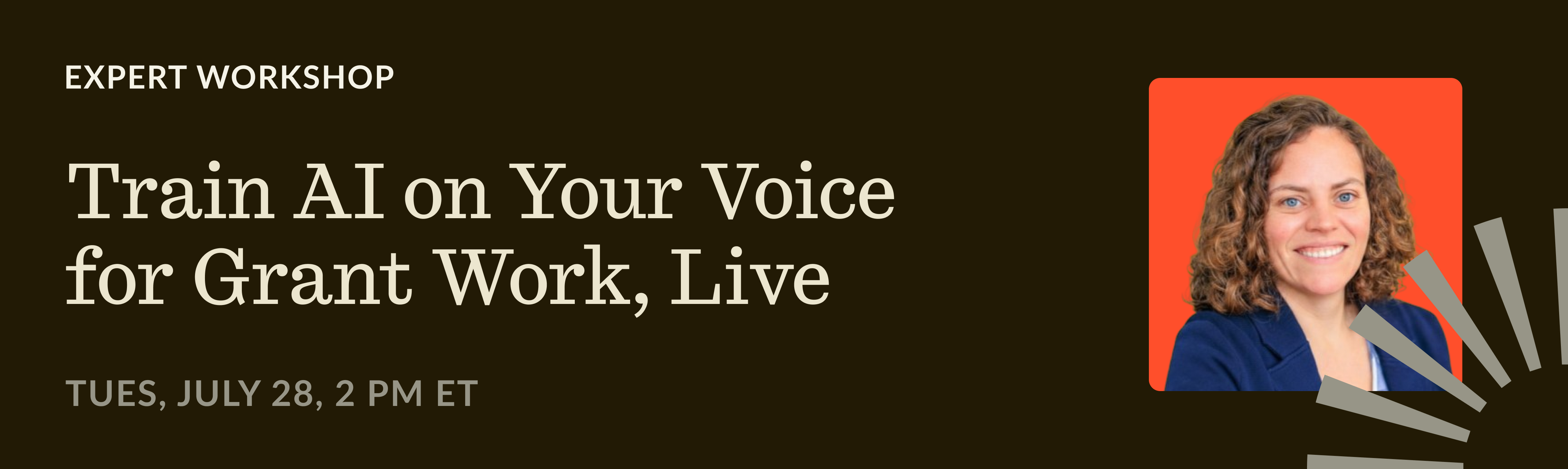
The #1 concern grant pros have about AI? Losing their organization's voice to generic output.
In this hands on workshop, you'll fix that live: build a voiceprint system that trains Claude or ChatGPT to write the way your team actually writes, and leave with it ready to use on your next grant.
On Tuesday, July 28th at 2pm ET, grants consultant Fielding Jezreel will join us to walk through the build.
You'll walk away with:
- A voiceprint document, built live, that trains Claude or ChatGPT to write in your organization's actual voice, plus a step by step handout to finish it
- The building blocks behind why AI drafts fall flat, and how to prompt so results hold up on your terms
- A smarter way to pair your new AI skills with a matching tool to surface best fit grant opportunities faster and streamline your grant workflows
Join us live for a chance to win free hours of AI grant consulting with Fielding.
Backed by new research from grant professionals on how AI is actually showing up in their work.
👉 Save your spot now - it's free!
The Uniform Guidance Overhaul: What's Trending in the Outcry
The response has been overwhelming. An analysis by researchers at the University of North Carolina at Chapel Hill, in partnership with the publication STAT, used a large language model to review the public comments and found that roughly 95% (of the 52,322 public comments) opposed the proposal.
What concerns are commenters flagging most? Perhaps unsurprisingly, these four rose to the top:
- Awards steered by political priorities. The single most-cited concern, raised in a majority of opposing comments: agencies could weigh whether a grant "advances the President's policy priorities" when deciding what to fund. This would include a new review step where political appointees vet proposals before they're funded, without saying whether or why one was rejected.
- Easier mid-award termination. This is the top operational worry for organizations, flagged by nearly 50% of respondents. Agencies would be able to end a grant because it no longer fits "the national interest" with no required hearing or appeal.
- A new 90-day pause. Agencies could suspend funding for up to 90 days while deciding whether to continue or end an award.
- A shift toward reimbursement. Grants could move from paying you upfront to reimbursing you after you've spent. You’d front the costs and wait (sometimes a long time) to be repaid.
The first two concerns dominated the public outcry. The last two are quieter, but for a small nonprofit they're the ones most likely to hit your bank account. Read STAT's full analysis here.
Pitfalls and Pointers
The proposed changes to Uniform Guidance are far from final, but that doesn't mean there's nothing you can do right now to prepare.
⚠️ Pitfall: Waiting to see what the final rule says
Waiting feels safe, but with an October 1 target, there's very little “react-later” window.
OMB is required to review the comments and respond to every substantive argument (in a very tight turnaround time) before it can issue a final rule, but responding isn't the same as agreeing. The rule can still be finalized largely as proposed.
💡 Pointer: Get your house in order before October 1
- Map your renewal calendar. Flag every federal award that renews, amends, or begins after October 1. Those meet the new terms first, start there.
- Know how much rides on one award. If a single federal grant is a big share of your budget, that's your biggest exposure under easier termination. You don't have to fix it by fall, but know the number.
- Stress-test your cash flow, and think through your response or options for pivoting. Model what a funding gap or a switch to reimbursement would do to you, and start thinking through alternative fundraising strategies based on at-risk programs.
- Centralize your award terms. When the rules land, your first question will be "what do our current agreements actually say?" Make that a five-minute pull, not a scramble across inboxes and drives.
Expert Perspectives
🏆 Rachel Werner on Preparing Well Without Panicking
We recently sat down with federal grants experts Rachel Werner and Fielding Jezreel to talk through the question on everyone's mind: what should you actually be doing while the rule is still up in the air?
Their throughline was steadying: don't try to solve for every scenario, just move on the things already in your control.
Rachel shared this might look like starting close to home, with your internal controls.
- Are your records accurate and complete enough to hold up if an audit or reporting request landed tomorrow?
- Are the right duties split across enough people to create real accountability?
These aren't glamorous fixes, but they're the foundation everything else rests on, and they don't depend on knowing what the final rule says.
Her advice for anyone feeling the weight of it all: "Start with the low-hanging fruit — what you can actually do within the time that you have."
You don't have to do everything at once. It’s easy to get swept up in the anxiety of this moment, but focus on what you can control, and what you can’t.
You don't have to be ready for everything by October 1. You just have to start with what's in front of you.
Open Grant Opportunities Spotlight
International Paper Grant - International Paper Company Foundation
Grant Amount: $2,500 - $10,000
Next Deadline: October 1, 2026 | Next cycle: October 1, 2027
Who It's For: 501(c)(3) nonprofits (and some government entities with a fiscal sponsor) located in communities where International Paper operates
The Details:
- Funds four "signature causes": education (with a focus on early literacy, birth through 3rd grade), hunger and food security, health and wellness, and disaster relief
- Funding can go toward general operating expenses, programs, or education / outreach. No capital expenses, salaries, endowments, or multi-year commitments
- Priority goes to requests within the signature causes that show active involvement from International Paper employees
What their past giving tells us:
- 26% of last year's awards went to new grantees
- Median award size of $3,500
U.S. Venture Program Grants — U.S. Venture/Schmidt Family Foundation
Grant Amount: Unspecified (Median grant size of $10,000 based on past giving)
Next Deadline: August 16, 2026 (quarterly grant cycles)
Who It's For: Public charities (501(c)(3) preferred) working on self-sufficiency, community enrichment, and support for vulnerable populations. Your organization needs a direct connection to a U.S. Venture team member or shareholder — through board membership, volunteering, or donor engagement.
The Details:
- Funds initiatives around self-sufficiency, community enrichment, and the well-being of vulnerable populations
- Supports programs, general operating expenses, and capital projects
- Prefers to fund alongside other partners. They typically won't be the sole funder, so come with other committed or pending support
What their past giving tells us:
- 54% of last year's awards went to new grantees
- Funder is based in Appleton, WI (Outagamie County), but past grantees span 22 states
🔍 Learn more about the opportunity!
Ready to find more good-fit opportunities? 🔍 Explore thousands of other grant opportunities now!
Networking Nook
💻 Workshop | Writing Grants That Get Read: How to Make Your Case Compelling (Free)
August 5, 2026 | 1:00 - 2:00 PM | The Nonprofit Cooperative
Your program is doing important work — but does your grant narrative make funders stop and take notice? In this hands-on workshop, nonprofit leaders will learn to write grant narratives that clearly communicate impact, align with funder priorities, and stand out in a competitive review.
Presenter Alexandra Cohen, founder of ANC Consult, brings a practical, no-nonsense approach to turning complex program models into clear, persuasive, funder-aligned narratives.
You'll cover:
- Framing the narrative: how to hook a reviewer from the first paragraph Writing for funder priorities: aligning your goals with a funder's mission without losing your own voice
- Avoiding common pitfalls: the jargon, typos, and structural mistakes that make reviewers put a proposal down
- You'll leave with a reusable narrative framework you can apply to your next application immediately.
Get your grant house in order before October 1
When the rules change, scattered systems cost you time you don't have. Instrumentl brings your full grants practice into one system of record, so you can see your deadlines, requirements, and exposure at a glance and act before it's a fire drill.
Sign up to get The Impact newsletter delivered to your inbox every week. Subscribe now!
100% Free Grant Writing Resources Straight to Your Inbox
